The use of cover crops to enhance climate-resilient in potato farming systems2026
Implications
Cover crops are recognized for their ability to improve soil structure. Northern regions are expected to see more heavy rainfall under climate change, worsening soil erosion and compaction. Under these conditions, cover crops may serve as an effective tool to protect soils and enhancing soil infiltration. However, the short growing season in Nordic countries
may limit the full development of cover crops before winter, potentially reducing their benefits.
Background and objectives
Cover crops are a promising strategy to improve soil health and resilience, but their establishment under Norway’s short growing season is poorly quantified. In potato systems, they can be sown during the preceding crop’s growth or after early harvested potatoes. Knowledge is limited to which species are best suited to Nordic conditions and their effects on soil structure. This study evaluated the aboveground biomass of three cover crop species, oilseed radish, Italian ryegrass, and oats, under real farm conditions in two major potato-growing regions and assessed their impact on soil structure.
Key results and discussion
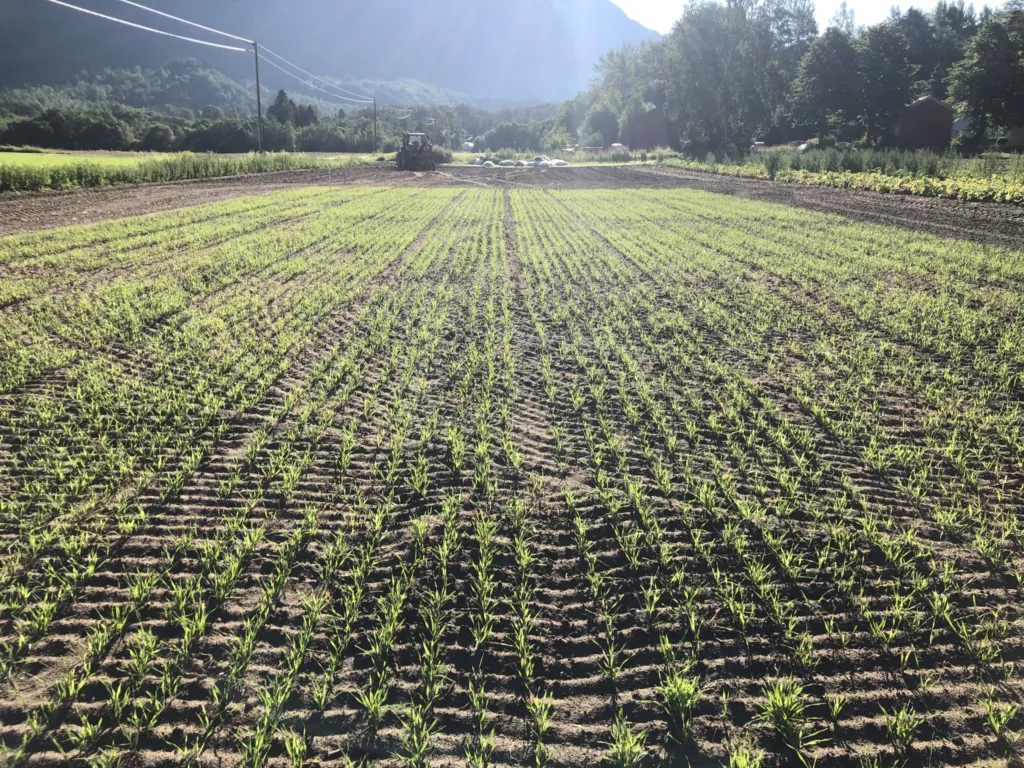
Cover crop aboveground biomass production varied substantially among species, years, and production systems. Italian ryegrass consistently produced the greatest autumn biomass, averaging 739 kg DM ha⁻¹ in 2024 and 1,167 kg DM ha⁻¹ in 2025 in late potato systems, and 832 kg DM ha⁻¹ in 2024 but only 24 kg DM ha⁻¹ in 2025 in early potato systems. Delayed sowing time was the primary factor explaining the low Italian ryegrass biomass observed in 2025. Oilseed radish and oats produced lower aboveground biomass than Italian ryegrass, with mean values of 180 kg DM ha⁻¹ in 2024 and 640 kg DM ha⁻¹ in 2025 for oilseed radish, and 290 kg DM ha⁻¹ in 2024 for oats. The establishment of oilseed radish and oat was more variable than for Italian ryegrass. Soil structure was assessed using the Visual Evaluation of Soil Structure (VESS) method in Italian ryegrass fields during spring and autumn. Spring assessments, conducted after winter and prior to cover crop termination, indicated minimal differences in soil structure between plots with and without Italian ryegrass in both potato systems. In autumn, when Italian ryegrass reached its highest growth potential, soils in the ryegrass plots were classified as having good structure, characterized by soil lumps easily broken by hand and consisting of small, rounded aggregates. In contrast, control plots without cover crops exhibited moderate soil structure, with aggregates hard to break by hand and with a mixture of rounded aggregates of varying sizes and the presence of some angular, less porous clods that may restrict root growth. Well-developed soil structure supports climate resilience, as it enhances water infiltration, root penetration, and resistance to compaction under increasingly frequency of heavy rainfall events.
On-farm assessment of cover crops in carrot and potato production under Norwegian conditions2025-10-06
To support a 50% increase in domestic vegetable production by 2035, Norway's potato and carrot value chains are exploring more sustainable cropping practices. Cover crops have emerged as a promising strategy to improve soil health and resilience, yet their establishment and effectiveness under Norway’s short growing season remain poorly understood. In this on-farm study, three cover crop species—oilseed radish, Italian ryegrass, and oats—were sown in late spring/summer (2024) across two key carrot and potato growing regions. Oilseed radish and oats showed poor establishment and produced negligible biomass before winter. In contrast, Italian ryegrass established successfully, producing autumn biomass yields ranging from 520 to 1320 kg DM ha⁻¹. Preliminary assessments in the following spring (2025) indicated trends toward improved biological soil indicators in cover-cropped plots, though effects were not statistically significant. Soil chemical and physical properties showed minimal change. Final evaluations of carrot and potato yield and quality are planned for late summer and autumn. These findings contribute to identifying cover crops with potential to enhance soil health and crop performance under real farm conditions in northern climates.
Jordhelse og sykdomshåndtering2025
Jordhelsefremmende tiltak bør tilpasses i konkrete planteproduksjoner for å ikke bli en del av problemet med jordbårne sykdommer, særlig i dyrkingssystemer der man ikke ønsker å bruke plantevernmidler. For å få det beste ut av vekstskifte og tilført organisk materiale, i forhold til sykdomsforebygging, må man lese seg opp på hvilke vekster som passer best etter hverandre og sammen. Det er også viktig å velge sorter av kulturvekster som er resistente eller motstandsdyktige og om mulig sorter som passer i økologisk drift. Ved å tilbakeføre organisk materiale, bruke vekstskifte og fangvekster for å fremme jordhelsa får man ikke en helt sykdomsfri jord, men man tilrettelegger for god jordstruktur, økt biologisk aktivitet, mangfold i jorda. Da får jorda også større motstandskraft mot klimasvingninger som tørke og store nedbørsmengder. Alt dette bidrar til å holde nivået av plantesykdommer lavt og kulturplantene friske. En del sykdomsforebygging ligger i god jordhelse, men ikke alt.
Effects of organic amendments and cover crops on soil characteristics and potato yields2024-07-07
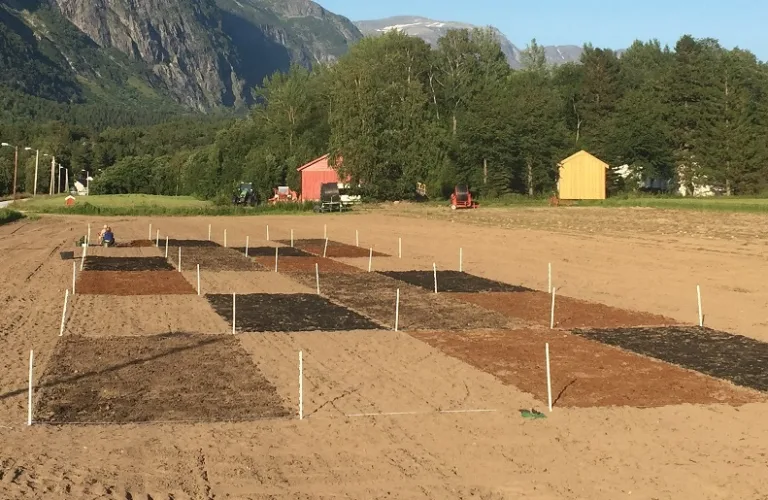
Intensive potato production may reduce the soil organic matter content (SOM), which may impact several soil functions and increase the incidence of potato diseases. We examined if cover crop and addition of organic materials may counteract these effects. Organic materials were one application of biochar mixed with liquid digestate (BLD); solid digestate (SD); or farmyard manure (FYM); with or without winter rye as cover crop, in a field with regular potato growing. Organic amendment increased SOM, especially for FYM and BLD, while cover crop did not affect SOM. Yet, cover crop increased tuber yields in the second year, and reduced the severity of potato diseases by 10% in post-harvest potatoes in both years. In the second year, the number of marketable potatoes after storage increased by 37% with cover crop. Organic amendments did not affect potato yield or quality, but the proportion of marketable potatoes tended to be higher in the amended soil. By lab incubation, BLD showed the largest potential for SOM storage, up to 32 years, followed by FYM and SD. Cover crops and organic amendments is recommended in potato production, especially for early potatoes where there is sufficient time after harvest to establish a good cover crop.
Inhibition of the development of Rhizoctonia solani by plant secondary metabolites – a laboratory study2024-07-07
Black scurf and stem canker on potatoes, caused by the destructive soil-borne pathogen Rhizoctonia solani Kühn are a major problem for potato growers worldwide. Biological control agents such as plant leaf extracts can influence the severity of R. solani infection and help to reduce the risks to human health and the environment associated with the use of hemical fungicides. In this study, the inhibitory effect of the secondary plant metabolites aucubin, catalpol (iridoid glucosides) and acteoside (phenylethanoid glycoside) from methanolic extracts of Plantago lanceolata (Ribwort plantain (en), Smalkjempe (no)), a native plant in the Nordic countries, on the growth of R. solani mycelium on potato dextrose agar growth medium will be tested for the first time. Plant extracts will be obtained from plants of different age classes and metabolic profiling will be performed with LC-(HR)MS analyses and the concentrations of identified metabolites will be determined. To analyse whether the inhibitory interactions on fungal growth originate from the known secondary metabolites or are caused by the bulk plant extract, we will first expose the fungus to different concentrations of extracts, redissolved in aqueous solution and added to the growth medium, and in a further step we will carry out the same approach with the isolated secondary metabolites as pure substances. The fugus will be incubated for 5 days and the mycelium growth radius will be measured every 24 hours during incubation. Thereafter a suppression index will be calculated and compared to the untreated control. The results are pending at the time of submission of the abstract but will provide a good initial understanding to determine whether extracts of P. lanceolata can be used as a natural biological control agent as an additional component of a more sustainable strategy to manage the risk of infection of potato with R.solani and to reduce the severity of the disease caused by this pathogen.
Effects of organic amendments and cover crops on soil characteristics and potato yields2023
Intensive potato production may reduce the soil organic matter content (SOM), which may impact several soil functions and increase the incidence of potato diseases. We examined if cover crop and addition of organic materials may counteract these effects. Organic materials were one application of biochar mixed with liquid digestate (BLD); solid digestate (SD); or farmyard manure (FYM); with or without winter rye as cover crop, in a field with regular potato growing. Organic amendment increased SOM, especially for FYM and BLD, while cover crop did not affect SOM. Yet, cover crop increased tuber yields in the second year, and reduced the severity of potato diseases by 10% in post-harvest potatoes in both years. In the second year, the number of marketable potatoes after storage increased by 37% with cover crop. Organic amendments did not affect potato yield or quality, but the proportion of marketable potatoes tended to be higher in the amended soil. By lab incubation, BLD showed the largest potential for SOM storage, up to 32 years, followed by FYM and SD. Cover crops and organic amendments is recommended in potato production, especially for early potatoes where there is sufficient time after harvest to establish a good cover crop.